.png)
Unlike many master’s programs that are coursework-only, Bard’s Graduate Programs in Sustainability (GPS) requires students to complete a capstone project or thesis during their final year. Students work one-on-one with a faculty advisor, developing applied, real-world solutions to complex challenges.
Capstone presentations at the end of each year serve as a culminating experience, showcasing student mastery and offering a meaningful exchange between graduates and faculty.
How Does Bard Define Sustainability in Graduate Education?
Bard defines sustainability as “Shared Well-Being on a Healthy Planet.”* This framework guides all capstone work, which spans both environmental and social challenges.
To ensure depth and rigor, Bard GPS requires all students to complete a capstone project demonstrating mastery within their program's theory of change:
- Changing the Rules (MS Environmental Policy; MS Climate Science and Policy)
- Changing Minds (M.Ed. in Environmental Education)
- Changing the Game (MBA in Sustainable Business)
Why Are Capstone Projects Central to Career-Ready Skills?
Capstones are designed to move beyond theory into implementation. Students tackle real-world issues, often partnering with organizations, communities, or industries.
Whether developing policy recommendations, advancing climate research, designing environmental education programs, or creating sustainable business strategies, students apply the knowledge and skills gained throughout their degree to produce work with tangible impact. The capstone experience helps prepare graduates to lead change in their fields and contribute meaningful solutions to today's environmental and social challenges.
Celebrating Outstanding Capstone Projects
Each year, faculty recognize outstanding capstone projects that reflect innovation, impact, and academic excellence. The 2026 honorees addressed urgent global challenges, including economic justice, healthcare systems, and climate impacts on food production.
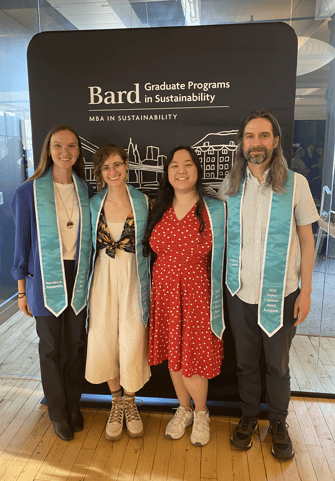
MBA Best Capstone (Co-Recipient): Madison Tillman
Toward a Culture of Repair: Land-Based Reparations in the Arkansas Delta
Madison examined how American slavery contributed to her family’s land wealth and developed a reparations strategy to return that wealth to impacted communities. In doing this, she created a powerful and clear model for other individuals with wealth to follow. She has just taken a job working for the Reparations Task Force in Philadelphia.
MBA Best Capstone (Co-Recipient): Max Dana
How to Steal a Million (From the Health Insurance Industry)
As co-founder of ArtsPool, a central-services cooperative for NGO’s in the NYC area, Max used his capstone to attack a critical issue facing his members: escalating health care costs. Max’s solution was the creation of a self-insurance pool, that on implementation, would save his community tens of millions of dollars over the next two decades. Max also outlined how the spread of this model in the US could fundamentally transform our health care towards a more just and efficient system.
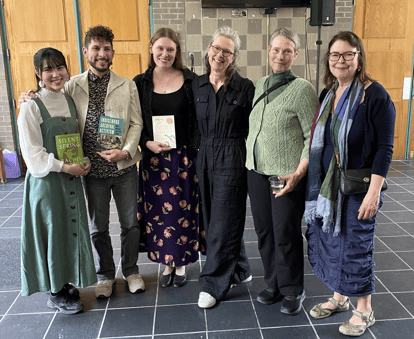
MS Environmental and Climate Policy – Rachel Carson Award for the Best Capstone: Emily Inoue
Climate Impact on Rice Quality: A Phenology-Based Study in Japan
Emily used advanced statistical analysis to show how rising nighttime temperatures are already affecting rice production. Her recommendations include adopting heat-tolerant cultivars and adjusting agricultural timelines to maintain food security.
What Other Sustainability Capstone Topics Did Students Explore?
Bard students addressed a wide range of interdisciplinary sustainability challenges, including:
- Rethinking Invasion: The Pedagogy of Invasive Species — Annabel Posimato, MEd
- Collaborative Governance and Community Engagement in Urban Forestry: A Policy Analysis of Philadelphia’s 2023 Tree Plan and Its Air Quality Priorities — Kim Eastlick, MS
- From Waste to Value: The Business Case for Sustainable Fashion — Camila Ramirez, MBA
- Planting Just Futures: Imagination as Transformative Praxis in Land-Centered Youth Participatory Action Programs — Ash Garcia, MEd
- Siting Battery Energy Storage Systems in the Hudson Valley: Contentious Politics and Lessons Learned for Local Municipalities — Kiara Carman, MS
- Farmer-in-Residence Program Design: A Financially Viable Pathway for the Next Generation of Regenerative Farmers — Malkie Rothman, MBA and Becky Hurley, MBA
These projects reflect the breadth of Bard’s programs and the diverse career pathways available to graduates.
From Capstone to Career
For many students, the capstone project becomes a bridge between graduate study and professional practice. By addressing real-world challenges and working with external partners, students build experience that can strengthen portfolios, inform career paths, and demonstrate their ability to create change in complex systems.
Bard GPS students graduate with more than a degree—they leave with a substantial piece of applied work that showcases their skills, interests, and approach to solving environmental and social challenges.
Learn More About Student Projects and Bard GPS
To explore additional student projects and hear directly from Bard GPS students and alumni, follow #BardMBAWins and #BardCEPWins on LinkedIn.
Interested in developing your own capstone project? Bard Graduate Programs in Sustainability offers graduate degrees in sustainable business, environmental policy, climate science and policy, and environmental education—each designed to help students turn ideas into action.

-1.jpg?width=365&name=IMG_7806%20(1)-1.jpg)