What’s changing in the sustainability consulting for business—and what does it mean for sustainability professionals?
In our News You Can Use series, we’re checking in with Bard MBA in Sustainability alumni and faculty to get their perspectives on the trends shaping their industries and what they mean for sustainability professionals.
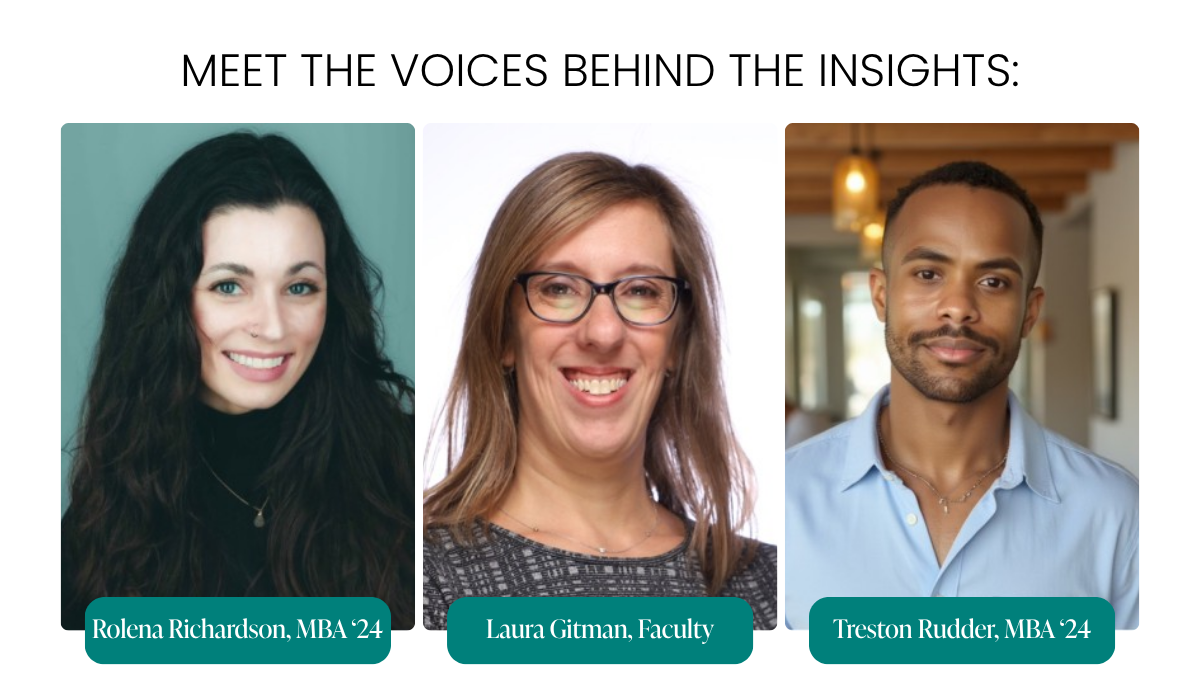
This week, we’re talking sustainability consulting, with Treston Rudder, Senior Consultant, Sustainability at WSP; Rolena Richardson, Co-Founder and General Manager of BIG Innovations Group Cooperative; and Laura Gitman, Bard MBA Faculty Member and Chief Impact Officer at BSR.
What trends are you seeing in sustainability consulting?
From helping companies scale solutions across the supply chain and integrating holistic, prioritized approaches, to fractional consulting in emerging markets, sustainability consulting is evolving across industries. Here’s what our alumni and faculty are seeing in their work.
Treston: Companies are adopting new ways of working to operationalize their sustainability commitments. When the solutions they need aren't available at scale, they're partnering across their value chain to build the market, using their own purchasing power to make the business case work. That shift from goal-setting to execution is where sustainability starts delivering real value.
Rolena: The growth of fractional and project-based work, particularly as small and midsize organizations look for expertise they may not need, or be able to afford, full-time. Through BIG Innovations Group, we’re seeing demand for support ranging from strategy development and financial modeling to community engagement and local wealth building. I find this exciting because fractional work challenges the idea that a meaningful career has to follow a single, linear path with one employer. It gives people more agency to curate a career around the problems they want to solve, build experience across industries and organizations, and create space to pursue opportunities that genuinely interest them.
Laura: Breaking down of siloes between issues and functions. For too long, there has been a climate community, a human rights community, nature & biodiversity, social impact, etc. While they had overlap, they also struggled to have a holistic perspective and this made it challenging for companies to manage these issues in an intersectional way. As companies really prioritize to focus on what matters most to their business, they are organizing according to their core business decisions or functions and need to look at their sustainability impacts in a more holistic manner.
What is your number one career advice for sustainability job seekers?
For sustainability job seekers, the ability to explain how sustainability creates business value is critical for opening doors. Our alumni and faculty also point out that employers are looking for people who know how to drive concrete results; and—sustainability doesn’t have to be in the title for a consultant to support impact outcomes in their work.
Treston: Understand how sustainability creates value for the business, and get comfortable explaining it to people who don't work in sustainability. As companies move from setting goals to executing them, more of the key decisions are made outside the sustainability org. People who can make that link are the ones who shape those decisions.
Rolena: Be a doer. There are a lot of people with good ideas. What distinguishes you is your ability to turn an idea into something actionable, bring a solution, think through the steps, and then execute. Some of the best opportunities I’ve had came from showing up, asking where I could contribute, and then delivering on what I said I would do. Especially in sustainability, where the problems can feel enormous, people who can move from “here’s what we should do” to “here’s how we can actually do it” are incredibly valuable.
Laura: Don't look for sustainability to be in the title — you can have sustainability impact in any role by bringing the right mindset and driving key decisions.
What are the most valuable aspects of the Bard MBA education for you?
Gaining practical consulting experience, learning from peers, and learning to think strategically are key components making a Bard MBA education valuable for sustainability consultants. Here’s what Treston, Rolena and Laura had to say.
Treston: The MBA program made my move into consulting possible. The year-long course in sustainability consulting, NYCLab, gave me real world consulting experience, so I had concrete work to point to when I made the switch. And because sustainability was built into every course, I learned to see it as a business issue rather than a separate specialty.
Rolena: Having the space and support to develop ideas into actionable business plans, and learning from a network of practitioners actively doing this work. Bard encouraged me to move beyond identifying problems and ask: What could I actually build or do to address them? That mindset has directly influenced how I approach entrepreneurship and my work building BIG Innovations Group. Just as importantly, learning from professors and peers with deep, real-world experience gave me a network I continue to draw on well beyond graduation.
Laura: What I learned from my own MBA was the ability to assess a market strategically—invaluable to evaluate my own organization, my clients, and any business opportunity. In terms of what I teach: how to break down and then solve a problem logically using the Pyramid Principle.
What’s next for sustainability consulting?
Sustainability consulting is evolving as companies move from setting ambitious goals to putting them into practice. That means organizations need professionals who can think strategically, work across business functions, and turn complex sustainability challenges into actionable solutions.
At the Bard MBA in Sustainability, students build those skills across the curriculum and put them into practice through NYCLab, our year-long sustainability consulting course. Working with real organizations on real business challenges, students gain the hands-on experience to help businesses turn sustainability strategy into action.
Want to build the skills to help lead that work?