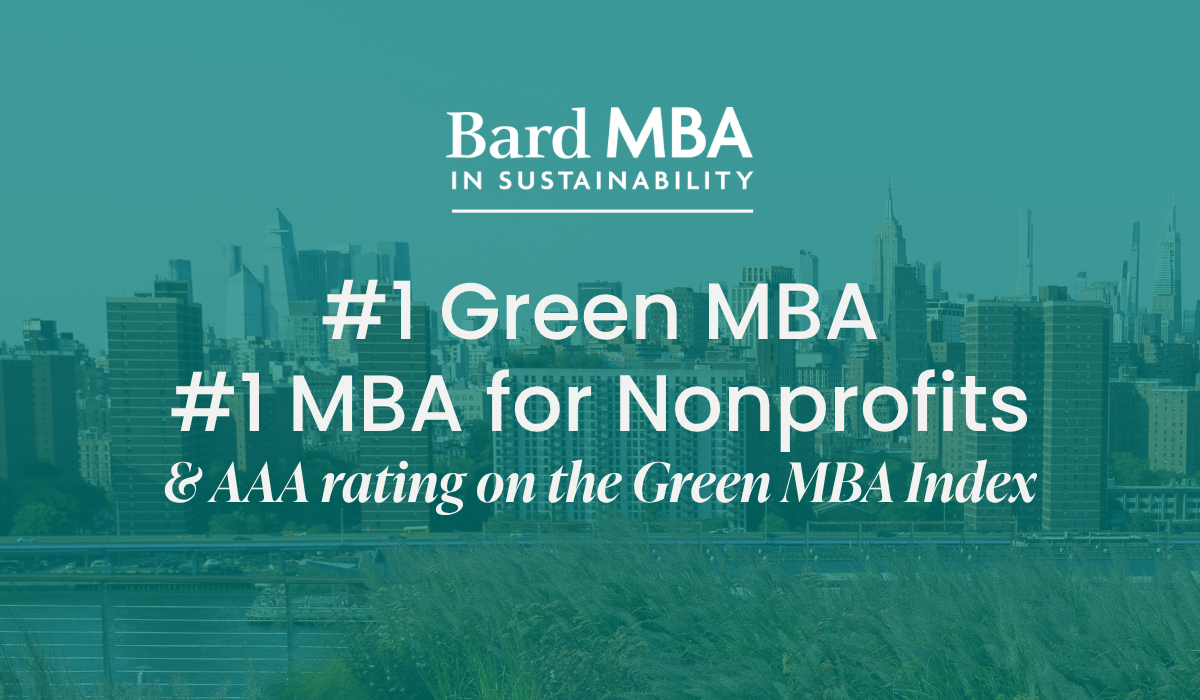
For the sixth consecutive year, Bard's MBA in Sustainability has been named the #1 Green MBA by The Princeton Review in the publication's 2027 business school rankings. The program also earned the #1 MBA for Nonprofits ranking for the third consecutive year, placing Bard ahead of other nationally recognized institutions including Yale, Harvard, Stanford, Cornell, Columbia, Berkeley, and Northwestern.
Unlike many business school rankings, The Princeton Review evaluations are based on student experience. The Best Green MBA ranking reflects how well students believe their MBA prepares them to address environmental, sustainability, and social responsibility issues throughout their careers, while the Best MBA for Nonprofits ranking recognizes programs that prepare graduates for mission-driven leadership.
That student perspective is reinforced by a very different kind of recognition. In July 2026, CEO magazine also awarded Bard an AAA rating in its Green MBA Index, which assesses how thoroughly sustainability is integrated into an MBA program's curriculum, hands-on learning opportunities, research, institutional strategy and graduate outcomes. The recognition builds on another recent distinction: in 2025, Corporate Knights named Bard the #1 MBA for impact in the world, recognizing the program for its exceptional alumni outcomes and leadership in preparing graduates to drive measurable impact in the sustainable economy.
Together, these recognitions point to the same conclusion: sustainability isn't an elective or concentration at Bard. It's the foundation of the Bard MBA in Sustainability.
Why Sustainability Is the Foundation of Bard's MBA
Business has changed. Today's leaders are navigating climate risk, evolving regulations, changing consumer expectations, artificial intelligence, and increasingly complex global supply chains. Success requires more than strong business fundamentals—it requires the ability to understand how environmental, social, and economic systems intersect.
That's why Bard takes a different approach.
Rather than offering sustainability as an elective or concentration, Bard's MBA in Sustainability weaves it throughout the curriculum. Every course—from finance and accounting to marketing, operations, leadership, and strategy—helps students understand how business decisions create both financial and environmental outcomes.
"As sustainability becomes increasingly central to business success, organizations need leaders who can connect financial performance with environmental and social outcomes," said Dr. Eban Goodstein, Director of the Bard MBA in Sustainability. "That's exactly what our students learn to do."
Graduates leave with the financial, strategic, and leadership skills expected of any MBA, along with the systems thinking needed to lead organizations through today's most complex challenges—whether they're working in the private sector, government, consulting, or nonprofit organizations.
Putting Learning into Practice
Bard's hybrid MBA is designed for working professionals who want to advance their careers while earning their degree. Monthly weekend residencies in New York City and online evening classes throughout the month allow students to immediately apply what they're learning to the work that they do every day.
The emphasis on real-world application can be found throughout the program. Through the year-long New York City Lab (NYCLab) consulting course, students work in teams to solve sustainability challenges for organizations such as McDonald's, Nasdaq, Target, and JLL. Students also complete an individually mentored capstone project, tackling a real issue aligned with their professional goals and preparing them to lead meaningful change after graduation.
Rather than waiting until they earn their degree, Bard students begin building the skills—and the impact—they'll carry throughout their careers.
One MBA. Countless Career Paths.
There's no single career path after Bard's MBA in Sustainability—and that's exactly the point.
Before enrolling at Bard, Jordan Sabine '21 worked on political campaigns and environmental policy. She came to the program with a clear goal: help transform one of the world's largest food systems from the inside. Today, she's the Manager of U.S. Sustainable Sourcing at McDonald's, working with suppliers to reduce emissions, strengthen climate resilience, and build a more sustainable global supply chain.
Jordan's story is just one example. Sam Brundrett '18 leads Etsy's work toward its net-zero climate goals. Emily Robichaux '18 helps finance clean energy and affordable housing projects at Amalgamated Bank. Beatrice Ajaero '17 founded Nneji, a mission-driven food business that combines entrepreneurship, cultural storytelling, and community impact.
Whether they're leading sustainability strategy for global brands, financing the clean energy transition, or launching businesses of their own, Bard graduates are proving that sustainability leadership is needed in every sector.
Why Bard Was Also Ranked the #1 MBA for Nonprofits
Bard's second #1 ranking reflects another defining characteristic of the program.
Mission-driven organizations face many of the same leadership challenges as corporations—financial sustainability, organizational strategy, governance, talent development, and long-term resilience. Bard prepares students to navigate those challenges while keeping mission at the center of every decision.
“The Bard MBA’s overall focus on steering mission-driven organizations provides a powerful foundation for aspiring non-profit leaders and managers,” said Unique Brathwaite, who anchors the non-profit concentration at Bard. “Our graduates emerge with a profound understanding of prioritizing mission, while also ensuring the long-term financial viability of their organizations.”
Whether students pursue careers in nonprofits, public agencies, B Corps, or private companies, they graduate with the tools to balance purpose and performance.
What These Rankings Really Mean
Being recognized as the nation's #1 Best Green MBA for the sixth consecutive year—and earning the #1 MBA for Nonprofits ranking once again—is an achievement worth celebrating.
But the rankings represent something more meaningful than a number.
They reflect the experiences of students who believe their education prepared them to solve complex problems, lead organizations through change and build careers that create lasting value.
As sustainability continues to reshape every sector of the economy, Bard remains committed to preparing the leaders who will help shape what comes next.

Frequently Asked Questions About Bard's MBA in Sustainability
Why is Bard ranked the #1 Best Green MBA?
The Princeton Review ranks Bard's MBA in Sustainability #1 based on student feedback about how well the program prepares graduates to address environmental, sustainability, and social responsibility issues in their careers. Rather than offering sustainability as a specialization, Bard integrates it throughout the entire MBA curriculum.
What is a Green MBA?
A Green MBA combines traditional business disciplines—such as finance, accounting, strategy, leadership, and operations—with sustainability, systems thinking, and social impact. Graduates learn how to create long-term business value while addressing environmental and social challenges.
Is Bard's MBA fully online?
No. Bard offers a hybrid MBA in Sustainability that combines monthly in-person weekend residencies in New York City with online evening classes, allowing students to continue working while earning their degree.
What careers can you pursue with an MBA in Sustainability?
Graduates work across corporate sustainability, strategy, consulting, nonprofit leadership, entrepreneurship, renewable energy, circular economy, impact investing, and sustainable finance — just to name a few fields.
How are The Princeton Review MBA rankings determined?
The Princeton Review's specialty rankings are based primarily on surveys of MBA students evaluating academics, career preparation, and campus culture. The Best Green MBA ranking specifically measures how well students feel their program prepares them to address sustainability, environmental, and social responsibility issues in their careers.
What does Bard's AAA rating from CEO Magazine mean?
Bard's MBA in Sustainability earned the highest possible AAA rating in CEO Magazine's 2026 Green MBA Index, which evaluates how thoroughly sustainability is integrated throughout an MBA program. Rather than focusing on a single course or concentration, the index examines curriculum, experiential learning, research, institutional commitment, and graduate outcomes.
*Editor’s note: Portions of this article were drafted with the assistance of AI technology and reviewed for accuracy and clarity by Bard College staff.