
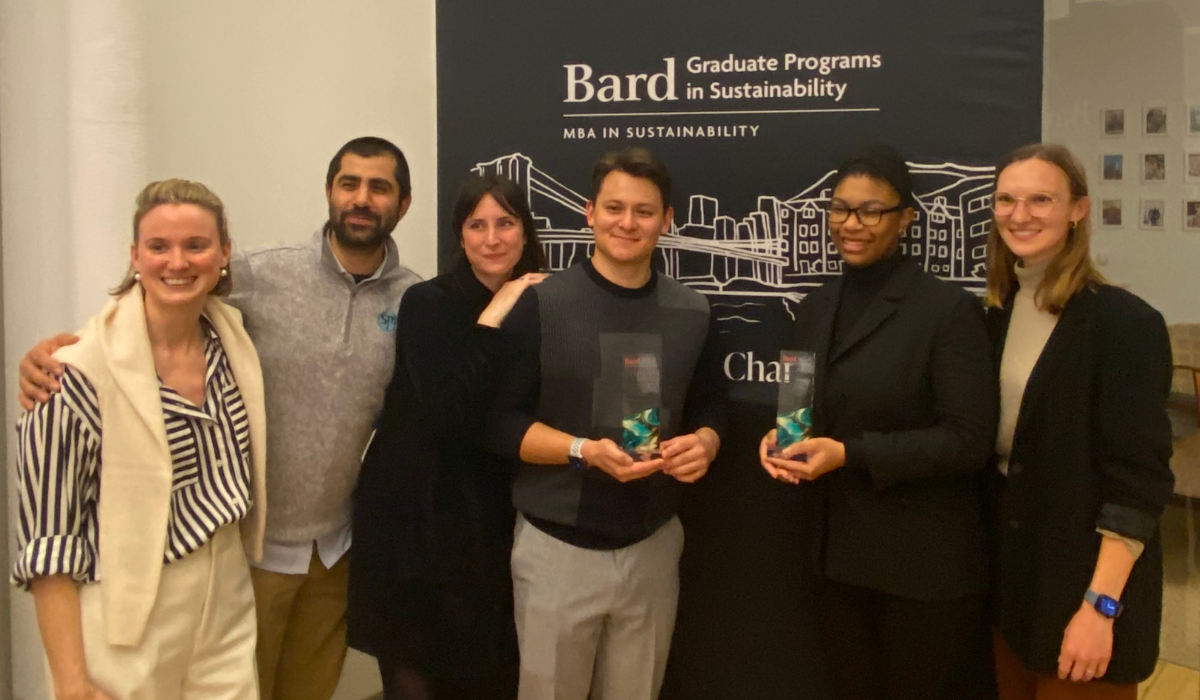
Across the world, economic inequality and ecological crisis are reinforcing one another. As climate disruption accelerates, long-standing injustices around land, housing, and wealth ownership are becoming impossible to ignore. At the same time, innovative entrepreneurs are reimagining how capital itself can become a force for repair and regeneration. These themes were on full display at the 2025 Bard MBA Pitch Competition, where student-led ventures focused on wealth justice, housing, and reparative finance took top honors.
Thrive Award: ROOTS Consulting Group
The Thrive Award, recognizing ventures “most likely to launch and thrive,” went to Coriana Johnson and Madison Tillman for their project ROOTS Consulting Group. ROOTS is a pioneering wealth justice business 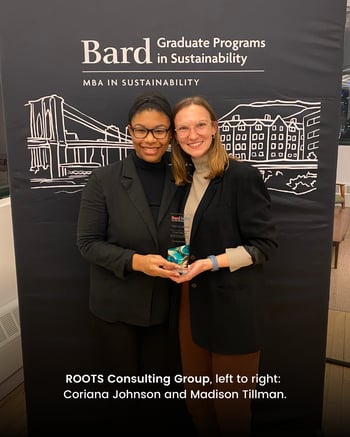 focused on mobilizing private capital for reparations and restorative justice. Working with high-net-wealth families, ROOTS provides historical research and consulting services that uncover the origins of accumulated wealth and guide clients toward meaningful, justice-centered giving strategies.
As the team explains, their work is about more than philanthropy. ROOTS aims to craft transformative land justice and reparative action solutions by pairing rigorous historical analysis with thoughtful client engagement—turning wealth redistribution into a deliberate, informed, and values-driven process. With a clear business model and tens of trillions of dollars on deck to change hands, the judges saw ROOTS as a venture well positioned to immediately thrive while delivering lasting social impact through sustainable business practices grounded in justice and accountability.
Catalyze Award: Common Ground Community REIT
The Catalyze Award, given to the venture “most likely to disrupt, shift systems, or catalyze change,” was awarded to Jasmine Graham, Lindsay Vick, Jake Rosenzweig-Stein, Casey Smith, and Arman Milanian 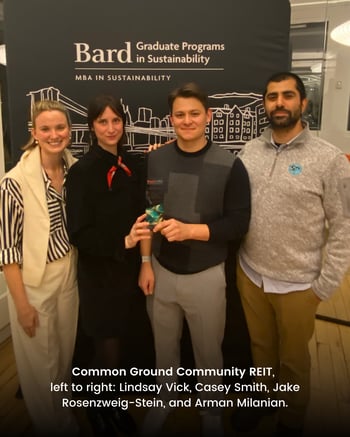 for Common Ground Community REIT. The team is developing a public, non-traded real estate investment trust that reimagines housing as a pathway to shared wealth rather than a permanent financial drain—directly addressing the ongoing housing crisis through innovative ownership models.
Common Ground Community REIT proposes a third option beyond renting or owning—one that transforms rent from a sunk cost into a wealth-building engine for residents and communities. By redesigning ownership structures to funnel a portion of monthly rent into tenant-owned accounts, the team aims to address the housing crisis at a systems level, aligning long-term affordability with collective asset building and community-centered economic development.
About the 2025 Bard MBA Pitch Competition
In total, 21 Bard MBA student teams competed this year, with participants drawn from both the New York City and New York Power Authority cohorts. A panel of distinguished first round judges narrowed the field to 5 final teams. Final-round judges included Bard MBA alumni Gabe Marks-Mulcahy ’14, Beatrice Ajaero ‘17, John Murray ‘22, and Elizabeth Kuzila ‘25; bringing perspectives from finance, entrepreneurship, design and impact investing to the evaluation process.
Radical reimagination lies at the heart of sustainable business leadership. In a world approaching ten billion people, sustainability can no longer be separated from questions of justice, ownership, and power. Businesses must innovate not only in how they produce energy, food, and housing, but also in how they distribute value—treating workers, communities, and ecosystems with dignity and respect.
Each year, and twice during their graduate course of study, Bard MBA students work in teams to develop and pitch bold ideas for a more just and sustainable future. The 2025 competition made one thing clear: the next generation of sustainability leaders is not just reducing harm—they are redesigning the systems that determine who benefits, who bears the costs, and what a thriving economy will look like.

.png?width=365&name=Blog%20Images%20(3).png)
