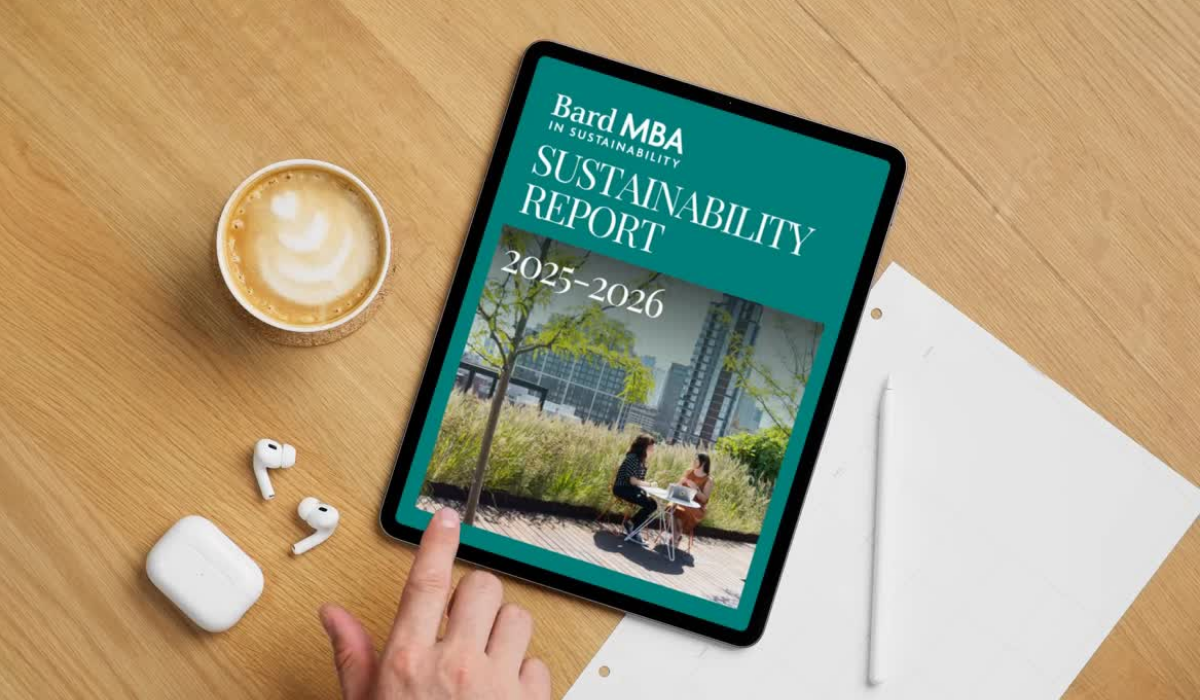
The Measurement and Reporting Committee is excited to announce the publication of the 2025-2026 Bard MBA Sustainability Report. For the eighth year, a student-led committee has taken on this project in its entirety — measuring our program's footprint, analyzing the data, and publishing the results in a way we can learn from to make improvements moving forward.
What's New in the Bard MBA Sustainability Report?
This year, the Committee — renamed from the ESG Committee to the Measurement and Reporting Committee to better reflect evolving terminology in sustainability reporting — continued the work of previous cohorts, refining our methodology and deepening the report's coverage of both Environmental and Social impact.
On the Environmental side, we tightened several methodologies this year:
- Transportation data now captures a wider range of travel modes, including e-bikes and e-scooters;
- Waste data comes from both a participant survey and a hands-on physical audit;
- Food emissions are calculated from actual per-dish servings via the EZcater catering platform rather than estimated attendance; and
- Book calculations now use confirmed fulfillment center addresses instead of assumptions.
The Social section saw its most significant expansion yet. Building on the program's JOI (Justice in Organizations & Impacts) framework, this year's report introduces a fuller Community section with profiles of students, faculty, and staff, alongside dedicated coverage of Partnerships and Student Leadership — putting a human face on the data and showing how the program's values translate into daily practice.
Key Findings from the 2025–2026 Sustainability Report
In 2025-2026, total program emissions came in at 96.79 metric tons of CO2e, a 37.9% drop from last year. 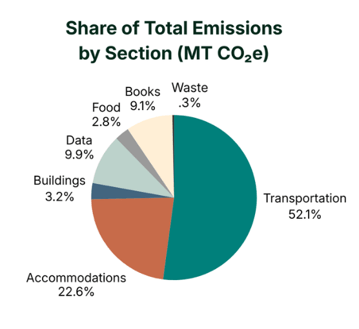 This reduction is attributed primarily to structural and external factors — a smaller cohort, more students local to New York, and two residencies that shifted partly remote due to winter weather — rather than to behavioral change alone.
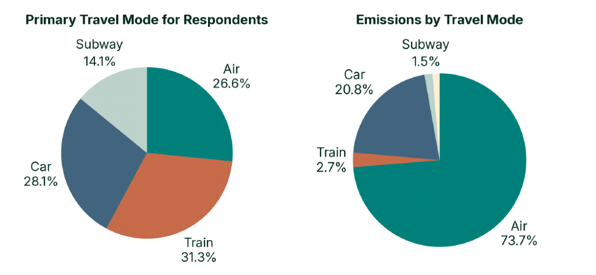
Consistent with prior years, transportation remained the largest emissions source for the Bard MBA in Sustainability, accounting for 52.1% of total emissions. Notably, air travel alone drove nearly 74% of transportation emissions despite being the primary travel mode for only about a quarter of respondents, highlighting how disproportionately flights shape the low-residency program's footprint compared to other modes.
One finding surprised us more than the headline numbers: our waste assessments found that 91% of what ended up in the trash stream this year was material that could have been recycled or composted. Sorting accuracy fell from 67% to 49% year over year, cutting the emissions we avoided through proper diversion by 66%. The emissions at stake are small relative to other categories, but this remains one of the clearest opportunities we identified for the program to act on.
On the social side, the new Community profiles put names and stories behind the numbers — from a student applying ancestral Iranian water and cooling practices to regenerative real estate work, to a faculty member who returned to teach in the program he graduated from, to a Dean of Students whose career centers on embedding equity into organizational systems. Together with continued reporting on scholarship access (95% of students received Bard-provided aid this year) and mission-aligned local partnerships, the Social section shows that the impact of the Bard MBA in Sustainability extends well beyond its carbon ledger.
Our 24-member student Committee is proud to share this report and invites you to dig into the full findings. Producing it means owning every stage of the sustainability reporting process — survey design, methodology development, data analysis, visualization and the editorial decisions about how to frame data honestly. It's the kind of hands-on experience in measurement and reporting that translates directly into the sustainability careers many of us are building toward, or already in, and we're grateful to the classmates, faculty, and administrators who helped make this year's report our strongest yet.
2025-2026 Measurement & Reporting Committee Members
Aneikit Bonnel, Annie Keating*, Arman Milanian*, Ashley Lamontagne, Bea Clark, Brianna Bell, Caroline Baloga, Chaya Huber, Dominique Mailloux, Eleanor Igwe, Eric Sargent, Garrett Feldman, Hannah Inman, Iman Abdullah, Izzy Defino, Jen Schaller, Kelly Pierson*, kk naimool, Kymberly Deane, Ravi Bhatia, Taylor King, Thuy-Linh Le*, Tuesday Smith, and Wendy Lau
*Committee Lead